
The Travel Bag Concept
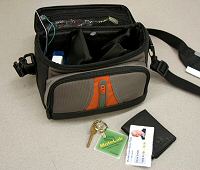
The Travel Bag is a part of the GO Navigation Project. Over the past year our research group has conducted focus groups and pilot studies, getting input from the brain injured population and other stakeholders on the difficulties they face when they leave their homes. Their input helped us design the Travel Bag system.
The Travel Bag system is designed to get its user out the door, on time,
with all of the items they will need on their trip. Once out the door it
will support the user with navigation instructions as necessary and monitor
the user's progress, contacting a care-provider if the need arises.
Our Current Prototype
Our current Travel Bag prototype is based on a number of components. The principle components are the bag itself, a desktop computer, a television (and related sensors), and information broadcasting stations in the field.
- The Bag
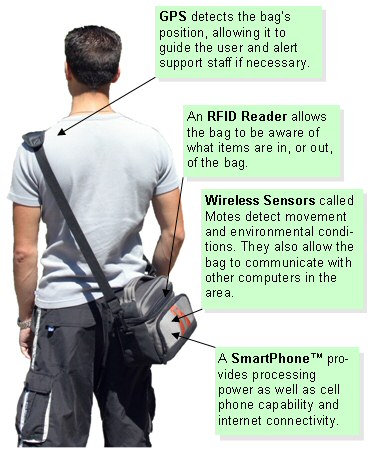
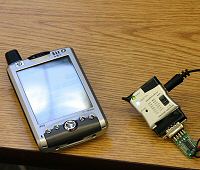
The processing power of the bag resides in a pair of Mica2 motes from Crossbow Technology and an iPaq SmartPhone. The Mica2 motes monitor several sensors including GPS, a tilt sensor, and an RFID reader from SkyeTek. The motes also provide radio communication between the bag and a desktop computer as well as any other sensors or base stations along the route. Craig Pataky provides excellent documentation of the Mica2 and Mica2Dot based components of this system on his website for Oregon Embedded. The iPaq is connected to a mote with wireless RS-232 via a Bluetooth-to-Serial module.
- The Desktop Computer
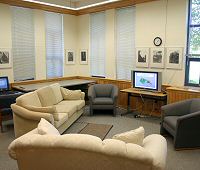
The desktop computer, residing in the user’s home, will coordinate trips. It loads trip information including destination, route, times, and items needed in to the TravelBag via the Mote Modem. This PC is responsible for deciding when to inform the user of the trip, tracking the bag inventory while inside the home, and displaying content on the television.
- The Television
When it is time for the user to leave the computer will make sure that the television is turned on, tuned to channel 3, and has sufficient volume. This is accomplished by monitoring a custom set of sensors attached to the television power and audio cabling. It allows our software to monitor the state of the television. An IR box allows us to control the television.
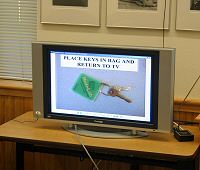
Once tuned to the proper station the television will display a message letting the user know it is time to leave on their trip. It also gives the user instructions to gather any items it detects are missing from the bag. Once all of the items are in the bag it prompts the user to leave the apartment.
- Broadcasting Stations
Along the route the user may come into contact with wireless broadcasting stations (Bus Stop Motes). These devices will communicate with the bag by sending multipart messages containing some relevant data. This might be real time bus schedules, suggestions about activities found near by, or entertainment content. Eventually interactive stations are envisioned.
Planned Longitudinal Study
In the near future we plan to deploy a new version of the Travel Bag system in apartments at an assisted living facility. This longitudinal study will help us determine the effectiveness of the Travel Bag system.
|
|
|
|
|
|
|
|
|
|
|
The TravelBag Research Group |
|
Principle Invenstigator: |
|
Prof. Stephen Fickas |
| Research Assistants: |
| Zebin Chen |
| Andrew Fortier |
| Craig Pataky |
| Terence Waggoner |
|
Xiangkui Yao |