
|

|

|
|
Architecture |
|||
| [Home] [Overview] [Architecture] [Scenario] [People] [Publications] | |||
(TIERRA)
|
|
|
|
|
Architecture |
|||
| [Home] [Overview] [Architecture] [Scenario] [People] [Publications] | |||
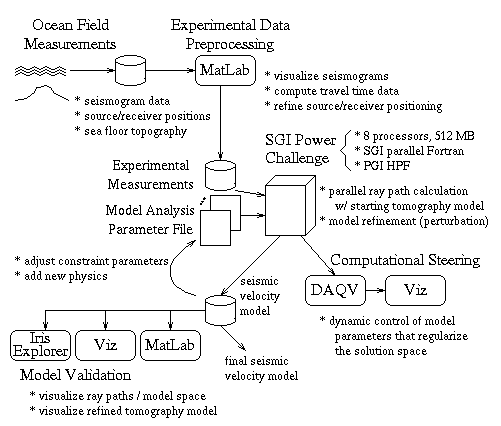
Seismic Tomography Computational Environment
DAQV provides high level access to parallel, distributed arrays of a running computation for visualization and analysis by external tools. The tomography code, written in HPF, is instrumented with DAQV library routines. The instrumentation defines which program data is available for access and also defines the points in the program (DAQV_YIELD points) where the data may be accessed or mutated by external clients. This has the effect of turning the HPF tomography code into a DAQV data server. DAQV provides a socket-based server interface and protocol for external communications to clients. A technical report provides a detailed discussion of DAQV.
VIZ is a visualization programming environment built on an interpreted, high-level language (Scheme) with object extensions (Meroon). A central component of our environment is a VIZ-based data client that allows seismologists to peruse their data at runtime. Users may turn on and off specific visualization features to observe the model space, slowness fields, and travel-time fields. For example, the thresholds of the slowness and travel-time isosurfaces can be changed via a slider button to effect steering control. A technical report provides a detailed description of VIZ.